


Hair thinning is not simply a normal part of ageing. For millions of women, it signals something specific happening beneath the scalp, something that science can now identify and address. Hair thinning is linked to specific causes rather than inevitable decline, and that changes everything. The right knowledge puts you back in control. This guide walks you through the real reasons your hair is thinning, how to identify your pattern, and which natural, evidence-backed solutions actually deliver results. No guesswork. No empty promises. Just clear, actionable steps.
Table of Contents
- What causes hair thinning in women?
- How to identify your hair thinning type
- Natural remedies and evidence-based solutions
- Best lifestyle strategies for fuller, healthier hair
- Why natural and multi-targeted solutions outperform ‘quick fixes’ for hair thinning
- Revitalise your hair journey with premium natural options
- Frequently asked questions
Key Takeaways
| Point | Details |
|---|---|
| Identify your hair thinning type | Spot the specific pattern and triggers to choose the right care approach. |
| Choose evidence-based natural solutions | Focus on botanicals, nutraceuticals, and premium products proven in research to boost hair density and strength. |
| Adopt supportive lifestyle practices | Nutrition, stress management, and gentle hair routines are crucial for lasting hair revival. |
| Be patient and consistent | It often takes 3–6 months to see results, so track progress and stick to your regimen. |
What causes hair thinning in women?
Hair thinning is not one single condition. It is an umbrella term covering several distinct processes, each with different triggers and timelines. The most common form is female pattern hair loss (FPHL), also called androgenetic alopecia. It involves a gradual miniaturisation of hair follicles, meaning each strand grows back finer and shorter over successive cycles until growth stops altogether.
Up to 50% of women experience FPHL at some point in their lives, with prevalence rising sharply after menopause. That is not a small number. That is half the female population.
So what drives it? Multiple triggers are involved, including:
- Genetics: A family history of thinning on either side increases your risk significantly.
- Hormones: Declining oestrogen and rising dihydrotestosterone (DHT, a hormone that shrinks follicles) are key drivers.
- Stress: Chronic stress pushes follicles into a resting phase, causing shedding weeks or months later.
- Nutritional gaps: Low iron, zinc, vitamin D, or protein starves follicles of what they need to grow.
- Medical conditions: Thyroid disorders, polycystic ovary syndrome (PCOS), and anaemia are common culprits.
It is also worth knowing that losing up to 100 hairs per day is considered normal. Shedding more than 125 hairs daily consistently signals that something needs attention.
Not all thinning is FPHL. Telogen effluvium is a temporary, stress or shock-triggered shed that resolves once the cause is removed. Women navigating postpartum hair loss often experience this type, and understanding the postpartum regrowth timeline helps set realistic expectations. Alopecia areata, another distinct type, involves immune-related patchy loss and requires specialist input.
Pro Tip: Keep a simple daily count for two weeks by collecting shed hairs from your brush, pillow, and shower drain. This gives you a real baseline before starting any treatment.
How to identify your hair thinning type
Recognising what is causing your hair thinning sets the foundation for targeted action. Not all thinning looks or behaves the same, and treating the wrong type wastes time and money.
FPHL presents with diffuse thinning at the crown, sparing the frontal hairline. This is the hallmark difference from male pattern baldness. You may notice a widening parting or a reduction in ponytail thickness before any visible scalp shows.

The Sinclair scale stages female hair thinning from 1 (minimal loss) to 5 (extensive crown thinning), giving clinicians and patients a shared language for progression.
| Thinning type | Pattern | Reversible? |
|---|---|---|
| FPHL | Crown, widening parting | Partially, with ongoing care |
| Telogen effluvium | Diffuse, all-over shed | Yes, once trigger resolves |
| Alopecia areata | Patchy, circular | Often, with treatment |
| Postpartum loss | Diffuse, temples | Yes, within 6–12 months |
Here is how to assess your own pattern:
- Check your parting. Is it wider than it was a year ago? That points to FPHL.
- Look at your temples. Recession here is common in postpartum and stress-related loss.
- Examine for patches. Smooth, circular bald spots suggest alopecia areata.
- Track timing. Did shedding start 2–4 months after a major stressor, illness, or birth? That is classic telogen effluvium.
- Note other symptoms. Fatigue, weight changes, or skin issues alongside hair loss often point to a medical cause.
When to see a doctor: Sudden, rapid loss, patchy bald spots, scalp pain or inflammation, or thinning accompanied by other body symptoms all warrant a GP or trichologist appointment. Blood tests and trichoscopy (a non-invasive scalp examination) can confirm the cause quickly.
Using a scalp massager regularly can also help you monitor scalp health and stimulate circulation as you track your progress.
Natural remedies and evidence-based solutions
Once you know your hair thinning type, selecting solutions with robust evidence ensures your efforts pay off. The good news is that natural and nutraceutical options have advanced significantly, with clinical data now backing several key ingredients.
Nutrafol and botanicals increase hair density and shaft diameter over 6 months, particularly in postmenopausal women. That is a meaningful result for a non-prescription approach.
Pumpkin seed oil, rosemary oil, and saw palmetto show substantial improvements in hair density and DHT reduction across multiple trials. Rosemary oil in particular has shown results comparable to minoxidil in some studies, with far fewer side effects.
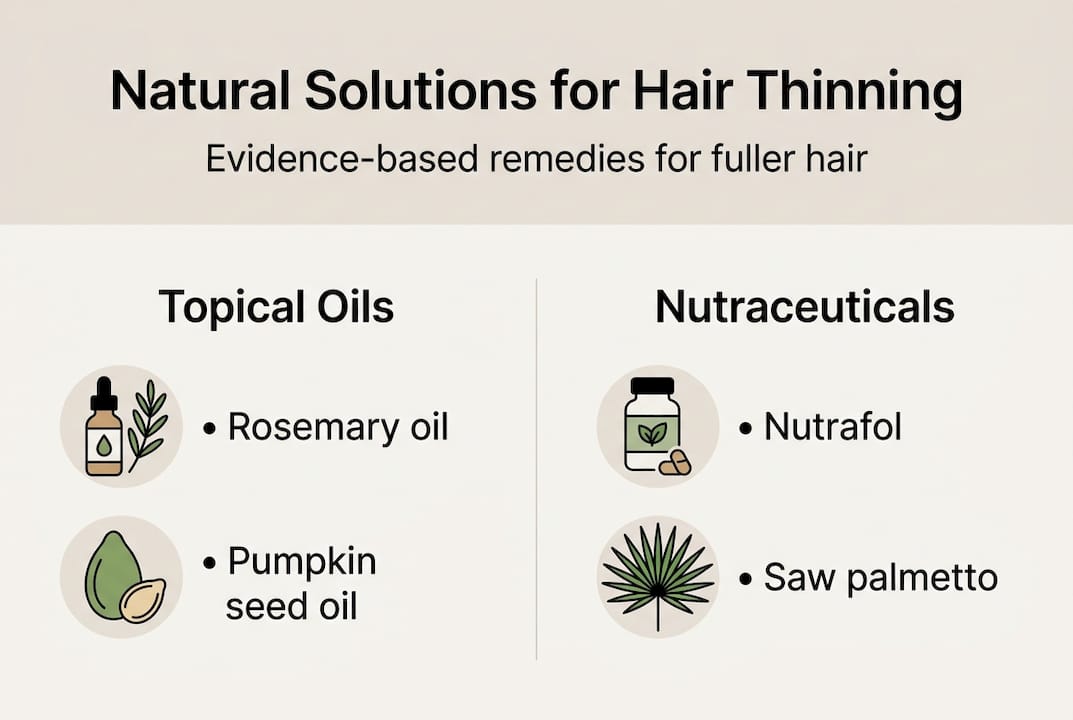
| Ingredient | Key benefit | Typical duration |
|---|---|---|
| Nutrafol | Density, shaft diameter | 6 months |
| Rosemary oil | DHT reduction, growth | 3–6 months |
| Pumpkin seed oil | Follicle protection | 3–6 months |
| Saw palmetto | DHT blocking | 6 months |
| Tocotrienols (vitamin E) | Antioxidant support | 4–6 months |
Premium products including Nutrafol Women’s Balance, Vegamour GRO, and Mielle Rosemary shampoos demonstrate measurable efficacy in clinical trials, making them credible adjuvant options alongside lifestyle changes.
Topical serums and shampoos work best as part of a layered routine. Explore natural hair growth serums designed for thinning hair, compare the best UK hair serums side by side, and learn how to select restorative hair oils that suit your specific pattern.
- Combine oral and topical: Nutraceuticals address internal deficiencies while topical botanicals stimulate the follicle directly.
- Commit to 3–6 months: Hair cycles are long. Expect early shedding reduction first, then visible regrowth.
- Choose clean formulations: Sulphate-free, paraben-free products protect scalp integrity during treatment.
Pro Tip: Pair a rosemary-based serum with a biotin-rich oral supplement for a combined internal and external approach. This dual strategy consistently outperforms single-ingredient routines in trials.
Best lifestyle strategies for fuller, healthier hair
Evidence-based treatments work best when combined with supportive everyday habits. Think of your lifestyle as the soil in which your hair treatments grow. Poor soil means poor results, regardless of the product.
Nutritional deficiencies, chronic stress, and improper scalp care all exacerbate hair loss, often silently. Addressing these factors is not optional. It is foundational.
Nutrition essentials for hair support:
- Iron: Low ferritin is one of the most common and overlooked drivers of female hair loss. Aim for ferritin levels above 70 µg/L.
- Zinc: Supports follicle repair and protein synthesis. Found in pumpkin seeds, legumes, and meat.
- Vitamin D: Deficiency is widespread and directly linked to follicle cycling disruption.
- Protein: Hair is made of keratin, a protein. Insufficient daily intake slows growth and weakens strands.
Stress management matters more than most realise. Cortisol, the stress hormone, directly disrupts the hair growth cycle. Consistent sleep of 7–9 hours, daily movement, and mindfulness practices like meditation or yoga all reduce cortisol levels over time. These are not optional extras. They are part of your hair revival strategy.
Gentle haircare protects what you have:
- Avoid tight ponytails, braids, or extensions that create traction on follicles.
- Limit heat styling and chemical treatments during active thinning periods.
- Use a wide-tooth comb on wet hair to minimise mechanical breakage.
Scalp health is equally critical. A healthy scalp is a productive scalp. Regular scalp massage increases blood flow to follicles and has shown measurable improvement in hair thickness. You can also learn how to combine scalp massagers with hair growth oils for maximum benefit.
Pro Tip: Every two weeks, photograph your parting under the same lighting and angle. This biweekly tracking method reveals gradual regrowth that daily observation misses entirely.
Why natural and multi-targeted solutions outperform ‘quick fixes’ for hair thinning
Stepping back from the data, it is worth asking why so many products disappoint despite bold claims. The answer is almost always the same: they target one pathway in isolation.
Hair thinning in women is rarely caused by a single factor. It is a convergence of hormonal shifts, nutritional gaps, stress load, and scalp environment. A shampoo alone cannot fix that. Neither can a single supplement.
Natural multi-targeted approaches offer better tolerability and address root causes without the side effects associated with single-drug treatments like minoxidil or finasteride. This is especially significant for menopausal women, who are more sensitive to hormonal side effects.
The women who see real, lasting results are those who commit to a layered strategy: oral nutraceuticals, topical botanicals, scalp care, and lifestyle support, sustained for at least three to six months. Quick fixes are costly, literally and emotionally. Explore natural serum options that fit this multi-targeted approach and start building a routine that actually works.
Revitalise your hair journey with premium natural options
You now know that real results come from addressing hair thinning at every level. Clean ingredients. Evidence-backed botanicals. Consistent daily habits. That is the formula.

At LUXEVASTORE, we have curated premium, cruelty-free hair revival products built around exactly this approach. Our biotin and rosemary shampoo set combines two of the most clinically supported ingredients for hair density and DHT reduction in one powerful, sulphate-free formula. ✨ Start your hair revival routine today. Shop now and give your hair the science-backed, plant-powered care it deserves. 🚀
Frequently asked questions
How do I know if my hair thinning is reversible?
Some forms are reversible; thinning from stress, nutrition, or temporary triggers can resolve once those causes are addressed, but FPHL tends to progress without ongoing intervention.
How long does it take for natural remedies to show results?
Noticeable results typically appear after 3 to 6 months of consistent use of nutraceuticals and topical botanicals, with early reductions in daily shedding often visible sooner.
Which nutrients are most important to support hair regrowth?
Iron, zinc, vitamin D, and high-quality protein are the most critical, as nutritional deficiencies directly disrupt healthy hair cycling and follicle function.
Can menopause trigger or worsen hair thinning?
Yes. Declining oestrogen after menopause accelerates thinning, and menopausal FPHL affects 52% of women, making targeted hormonal and nutritional support especially important during this stage.
Recommended
- Scalp hair loss in women: clean, science-backed solutions – LUXEVA
- Combat Postpartum Hair Loss: Natural Tips & Treatments That Work – LUXEVA
- Hair Follicle Repair: Restoring Natural Strength and Vitality – LUXEVA
- Natural remedies for extremely dry scalp: 4 proven methods – LUXEVA
- How to prevent skin aging naturally: Guide for women 40+