


Nearly 50% of women face scalp hair loss at some point in their lives, yet most are handed vague advice, ineffective products, or a shrug from a GP. That is frustrating. The good news is that most female hair loss is not a life sentence. Science has advanced rapidly, and clean, premium solutions now exist that genuinely work. Whether you are noticing a wider parting, more hair on your pillow, or a scalp that feels exposed under bright light, this guide cuts through the noise. You will leave with a clear understanding of causes, proven treatments, and the daily habits that make the biggest difference.
Table of Contents
- Common causes of scalp hair loss in women
- How science deciphers and treats female scalp hair loss
- The power of natural and clean-ingredient solutions
- Diet, lifestyle and smart routines for stronger roots
- Why clean, multi-targeted routines are the future for women’s hair health
- Explore evidence-backed, premium hair solutions
- Frequently asked questions
Key Takeaways
| Point | Details |
|---|---|
| Types of hair loss | Female pattern and telogen effluvium are the main types causing women’s scalp hair loss. |
| Diagnosis is key | Trichoscopy, bloodwork, and understanding of triggers lead to effective, targeted treatments. |
| Nature and science blend | Clean-ingredient botanicals like saw palmetto, curcumin, and Nutrafol show major efficacy in clinical studies. |
| Routines enhance results | Nourishing diets, smart haircare, and gentle products maximise growth alongside medical or natural approaches. |
| Multitarget approaches win | Combining several evidence-based tactics outperforms single products for long-term hair health. |
Common causes of scalp hair loss in women
With an understanding of how common scalp hair loss is, let’s break down its main causes. Not all hair loss is the same, and identifying your type is the first step to fixing it.
The main types of female hair loss:
- Female pattern hair loss (FPHL): The most common type. Diffuse thinning across the crown, usually with a preserved frontal hairline. FPHL affects up to 50% of women and is driven by genetics, androgens, and microinflammation.
- Telogen effluvium (TE): Sudden, excessive shedding triggered by shock to the system. TE involves temporary shedding commonly caused by hormonal shifts, nutritional deficiencies, or major stress.
- Alopecia areata: An autoimmune condition causing patchy, unpredictable loss anywhere on the scalp.
- Scarring alopecias: Rarer conditions where inflammation permanently destroys follicles. Early diagnosis is critical here.
Key triggers to watch for:
| Trigger | How it causes loss |
|---|---|
| Hormonal changes | Menopause, postpartum shifts disrupt follicle cycles |
| Genetics | FPHL runs in families on both sides |
| Nutritional gaps | Low iron, vitamin D, or protein starve follicles |
| Chronic stress | Pushes follicles into resting phase prematurely |
| Medications | Certain contraceptives, antidepressants, and blood thinners |
“Scalp hair loss in women is almost never just one thing. It is a combination of triggers acting on a genetically predisposed scalp.”
How is it diagnosed? A dermatologist or trichologist will use a pull test, trichoscopy (a magnified scalp examination), or occasionally a scalp biopsy. These tools distinguish FPHL from TE and rule out scarring conditions. Understanding scalp care for healthy hair also starts with knowing which type of loss you are dealing with. Getting this right saves months of wasted effort on the wrong products.
How science deciphers and treats female scalp hair loss
Understanding what is behind scalp hair loss sets the stage for exploring how science addresses it. Diagnosis guides everything. Trichoscopy, pull test, and biopsy are used to distinguish FPHL from scarring alopecias and to rule out hormonal causes before any treatment begins.
Treatment options ranked by evidence:
- Topical minoxidil: The only FDA-approved treatment for female pattern hair loss. Applied directly to the scalp, it extends the growth phase of follicles.
- Oral minoxidil (low dose): Increasingly used off-label with strong clinical support and often better tolerated.
- Anti-androgens (spironolactone, finasteride): Off-label but widely prescribed for women with hormonal-driven FPHL.
- Platelet-rich plasma (PRP): Injections of concentrated growth factors from your own blood. Emerging evidence is promising.
- Low-level laser therapy (LLLT): Devices like laser combs and caps stimulate follicle activity with light energy.
- Topical botanicals: Rosemary oil, saw palmetto serums, and pumpkin seed oil blends are gaining strong clinical backing.
| Approach | Evidence level | Timeframe for results |
|---|---|---|
| Topical minoxidil | High (FDA-approved) | 3 to 6 months |
| Oral minoxidil | Moderate to high | 3 to 6 months |
| PRP therapy | Moderate | 3 to 6 months |
| Rosemary oil | Moderate | 3 to 6 months |
| Biotin supplements | Low | Variable |
Pro Tip: Combining treatments consistently outperforms single-agent approaches. Pairing a topical botanical serum with dietary support and stress management delivers results that minoxidil alone rarely achieves. Check out our hair growth serums comparison to see how leading options stack up.
Patience is non-negotiable. Visible regrowth typically appears after 3 to 6 months of consistent use. Stopping treatment early is the single biggest reason women report failure.
The power of natural and clean-ingredient solutions
Pharmaceuticals are not the only option. Natural solutions can rival or enhance standard treatments, and for women prioritising clean beauty, they are often the smarter long-term choice.
What makes natural solutions so compelling is their ability to address multiple root causes at once. Hormonal imbalance, scalp inflammation, and oxidative stress all contribute to hair loss. Clean botanical blends tackle all three simultaneously.
Top evidence-backed botanicals:
- Saw palmetto: Blocks DHT (the androgen that shrinks follicles) at the scalp level. Natural supplements with saw palmetto increase hair density and are especially effective in women.
- Pumpkin seed oil: Shown to produce up to 40% density gains in clinical settings.
- Curcumin: A potent anti-inflammatory that calms scalp microinflammation, a key driver of FPHL.
- Rosemary oil: Rivals minoxidil in some studies for stimulating follicle activity without scalp irritation.
- Maca (phytoestrogen): Particularly beneficial for menopausal women by supporting hormonal balance naturally.
| Botanical | Primary action | Best for |
|---|---|---|
| Saw palmetto | DHT blocking | Hormonal FPHL |
| Rosemary oil | Circulation boost | General thinning |
| Curcumin | Anti-inflammatory | Scalp microinflammation |
| Pumpkin seed oil | DHT and density | Androgenic loss |
| Maca | Hormonal balance | Menopausal women |
Nutrafol’s standardised blend increased women’s hair density with a standardised mean difference of +0.90 in clinical trials. That is a meaningful, measurable result.
Pro Tip: Choose clean formulations with no fillers, artificial fragrances, or synthetic binders. These additives irritate sensitive scalps and undermine the benefit of the active botanicals. Browse our products for scalp health and natural scalp care guides to find the right fit for your routine.

Diet, lifestyle and smart routines for stronger roots
Integrating science-backed natural and pharmaceutical options works best alongside daily routines. What you eat, how you sleep, and how you handle your hair all directly influence follicle health.
Nutritional priorities for hair regrowth:
- Iron: Ferritin levels below 30 ng/mL are strongly associated with increased shedding. Get a blood test before supplementing.
- Vitamin D: Deficiency is widespread and directly linked to follicle cycling disruption.
- Protein: Hair is made of keratin. Without adequate dietary protein, your body deprioritises hair growth.
- Zinc and selenium: Support scalp immunity and reduce inflammation.
- Omega-3 fatty acids: Found in oily fish and flaxseed; reduce scalp inflammation and support the hair growth cycle.
Balanced iron, vitamin D, and circulation-supporting habits are foundational to hair regrowth. No serum compensates for a nutrient-depleted body.
Smart daily habits that protect your roots:
- Scalp massage for 4 minutes daily increases blood flow to follicles and has shown measurable thickness improvements in studies.
- Wash hair with lukewarm water, not hot. Heat strips the scalp’s protective barrier.
- Use a wide-tooth comb on wet hair. Mechanical damage from brushing is a silent contributor to breakage.
- Prioritise 7 to 9 hours of sleep. Growth hormone, which drives follicle activity, peaks during deep sleep.
- Manage chronic stress actively. Cortisol directly pushes follicles into the resting phase.
Pro Tip: Avoid megadosing biotin. It offers little extra benefit for most women and can interfere with thyroid and cardiac lab test results, leading to misdiagnoses. Explore our scalp care tips, hair growth rituals, hair wellness habits, and postpartum hair loss tips for routines tailored to your specific situation.
Why clean, multi-targeted routines are the future for women’s hair health
With all the options laid out, it is time for a fresh perspective on what truly works. Here is the uncomfortable truth: single-agent approaches consistently underperform. Relying solely on minoxidil, or taking a biotin supplement and hoping for the best, misses the complexity of how female hair loss actually works.
Multi-target natural approaches address root causes more effectively than single agents, and this is especially meaningful for women seeking long-term scalp health. Nutritional gaps, hormonal fluctuations, chronic stress, and scalp inflammation rarely arrive alone. They stack. A routine that only addresses one of these factors leaves the others unchecked.
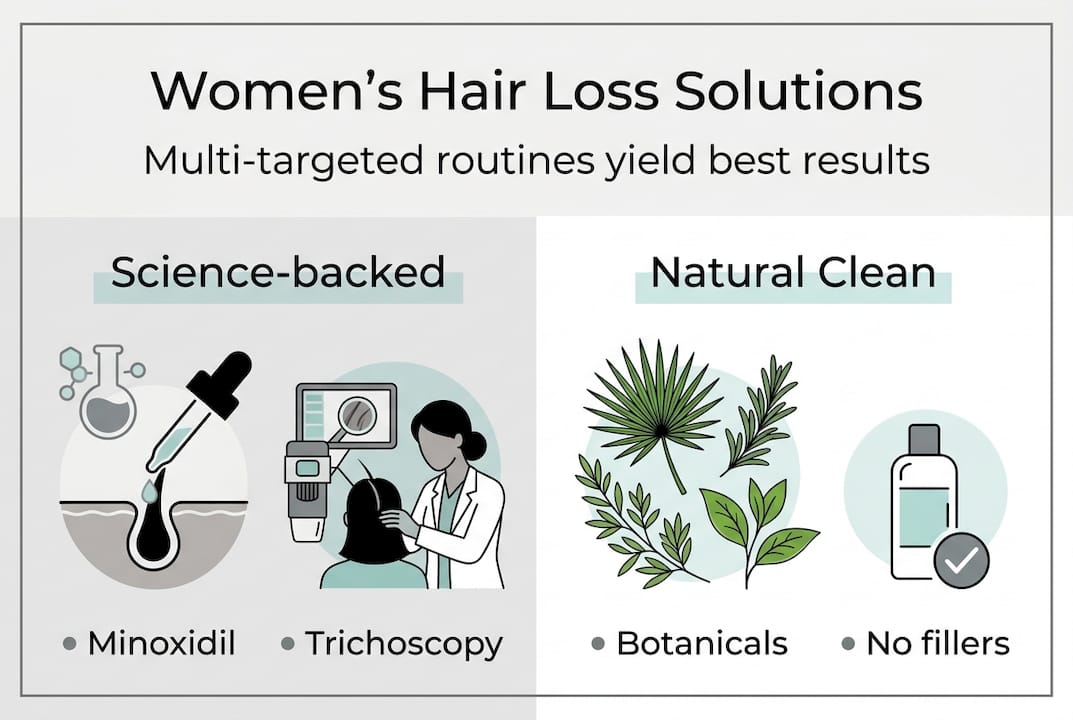
What we have seen, both in clinical data and in the experiences of real women, is that personal routine matters as much as product choice. The woman who pairs a clean botanical serum with consistent scalp massage, adequate protein, and genuine stress management consistently outperforms the one who simply applies minoxidil twice a day and waits.
Women are rewriting the hair loss narrative. They are rejecting trend-driven hype and demanding clean science. They want to know what is in their products, why it works, and whether it has been tested. That is not a niche preference. It is the future of hair health. Explore our top scalp care products to see how clean, multi-active formulations are raising the standard.
Explore evidence-backed, premium hair solutions
If you are ready to put this knowledge to work with evidence-based, luxury haircare, LUXEVA has you covered. ✨

Our curated range targets scalp health, growth, and shine using clean, plant-powered ingredients that align with the science in this guide. The Growlux hair scalp ritual set delivers a complete multi-step routine designed for thinning scalps. For daily cleansing with active botanicals, the Biotin & rosemary shampoo combines two of the most evidence-backed ingredients in one formula. Add the Argan oil hair set for repair, heat protection, and brilliant shine. 🚀 Premium. Clean. Results-driven. Shop now.
Frequently asked questions
What is the most common cause of scalp hair loss in women?
FPHL affects up to 50% of women and is multifactorial, driven by genetics, hormones, and scalp microinflammation acting together over time.
How soon can I see results from clean, natural hair loss solutions?
Most women see visible improvements in density and reduced shedding after 3 to 6 months of consistent use, as clinical studies of Nutrafol confirm.
Do natural supplements really work for female scalp hair loss?
Yes. Supplements such as saw palmetto, pumpkin seed oil, and Nutrafol have demonstrated significant increases in hair density for women, particularly those experiencing menopausal or hormonal-driven loss.
Should I avoid over-the-counter biotin for hair loss?
Excessive biotin offers little extra benefit and can interfere with medical test results; balanced nutrition across all key nutrients is far more effective for most women.
Recommended
- Scalp Care for Women – The Key to Hair Vitality – LUXEVA
- Natural remedies for extremely dry scalp: 4 proven methods – LUXEVA
- Scalp Massage and Hair Growth: Science and Real Impact – LUXEVA
- Combat Postpartum Hair Loss: Natural Tips & Treatments That Work – LUXEVA
- Protect your hair: role of extensions in hair loss explained