


TL;DR:
- Over 50% of women experience hair thinning caused by genetics, hormonal shifts, stress, or nutritional deficiencies.
- Recognizing signs like a widening part or sudden shedding helps tailor effective natural and medical treatments.
- Combining holistic lifestyle changes with targeted, cruelty-free products yields the best results for restoring hair health.
Over 50% of women experience noticeable hair thinning at some point in their lives, yet most still believe it is rare or simply unavoidable with age. That belief keeps too many women stuck, trying product after product without addressing what is actually driving the loss. The truth? Most causes of hair thinning are identifiable and many are treatable. Whether you are in your twenties dealing with post-pill shedding or in your fifties navigating menopause, effective options exist. This guide covers the real causes, how to recognise your specific type of thinning, and the evidence-based natural solutions that genuinely restore volume and health.
Table of Contents
- Why does hair thinning happen in women?
- Decoding the signs: recognising different types of hair thinning
- Natural solutions and lifestyle changes that restore hair volume
- Medical, pharmaceutical, and alternative treatments: what actually works?
- What most approaches get wrong about hair thinning in women
- Restore volume and confidence with premium, cruelty-free solutions
- Frequently asked questions
Key Takeaways
| Point | Details |
|---|---|
| Hair thinning is common | Over half of all women will experience hair thinning during their lives. |
| Root causes matter | Treating nutritional, hormonal, or stress-related causes delivers lasting results. |
| Natural solutions can help | Botanicals like saw palmetto and pumpkin seed oil support thicker hair safely. |
| Consistent care is key | You can expect visible improvements within three to six months with the right approach. |
| Cruelty-free products work | Premium vegan and cruelty-free formulas can be effective when combined with holistic routines. |
Why does hair thinning happen in women?
Hair thinning in women is far more complex than a single cause. Understanding what is driving yours is the first step to fixing it. The primary causes include female pattern hair loss (FPHL), telogen effluvium, hormonal shifts, genetics, chronic stress, nutritional deficiencies, certain medications, and underlying health conditions.
Female pattern hair loss (FPHL) is the most common type. It is genetic and driven largely by androgens, particularly dihydrotestosterone (DHT). DHT causes hair follicles to shrink over time, producing thinner, shorter strands until growth stops altogether. Crucially, FPHL does not require high androgen levels to occur. Even normal levels can trigger it in women with sensitive follicles.
Telogen effluvium (TE) works differently. Rather than follicle shrinkage, a physical or emotional shock pushes a large number of follicles into the resting (telogen) phase simultaneously. The result is sudden, diffuse shedding, often appearing 2 to 3 months after the trigger. Common triggers include childbirth, surgery, rapid weight loss, illness, or prolonged stress.
Here is a quick breakdown of the most frequent causes:
- Hormonal changes: Menopause, thyroid disorders, polycystic ovary syndrome (PCOS), and stopping hormonal contraception
- Nutritional gaps: Low ferritin (stored iron), vitamin D deficiency, and inadequate protein intake
- Stress: Both acute and chronic stress can push follicles into the resting phase
- Medications: Antidepressants, blood pressure drugs, and retinoids are known culprits
- Underlying conditions: Autoimmune conditions such as alopecia areata
| Cause | Mechanism | Reversible? |
|---|---|---|
| FPHL | Follicle miniaturisation via DHT | Manageable, not fully reversible |
| Telogen effluvium | Follicles pushed into resting phase | Often yes, once trigger resolves |
| Nutritional deficiency | Disrupted hair growth cycle | Yes, with repletion |
| Thyroid disorder | Hormonal imbalance disrupts cycle | Yes, with treatment |
| Alopecia areata | Autoimmune follicle attack | Variable |
If shedding is sudden and diffuse, TE is the likely culprit. If thinning is gradual and concentrated at the parting, FPHL is more probable. Explore the full picture of thinning hair causes and consider science-backed scalp solutions as part of your approach.
Worth knowing: A single episode of intense stress can cause you to lose up to 70% more hair than usual in the months that follow, yet the follicles are rarely permanently damaged.
Decoding the signs: recognising different types of hair thinning
Understanding the underlying cause is only half the battle. Next, learn to spot the tell-tale signs and get clarity on your own situation.
FPHL and telogen effluvium have distinct mechanisms: FPHL involves DHT-induced follicle miniaturisation, while TE pushes follicles into the resting stage. Distinguishing between them is key to choosing the right response.
Signs of FPHL:
- A widening centre parting
- Reduced ponytail thickness
- Diffuse thinning across the crown
- Gradual onset over months or years
Signs of telogen effluvium:
- Sudden increase in daily shedding
- Hair loss across the entire scalp, not just the crown
- A clear trigger event 2 to 3 months prior
- Hair often regrows once the trigger is removed
Here is a simple comparison to help you self-assess:
| Feature | FPHL | Telogen effluvium |
|---|---|---|
| Onset | Gradual | Sudden |
| Pattern | Widening part, crown | Diffuse, all over |
| Trigger | Genetic, hormonal | Stress, illness, diet |
| Regrowth | Slow, partial | Often full |
A straightforward home test is the pull test: grip 40 to 60 hairs between your fingers, pull gently from root to tip. Losing more than 6 hairs suggests active shedding. Track density changes monthly using the same photograph in the same lighting.
For a more precise picture, a trichologist can perform trichoscopy, a non-invasive scalp examination that identifies follicle miniaturisation. Blood tests checking ferritin, thyroid function, vitamin D, and androgens help rule out treatable causes. Browse hair thinning solutions and natural fixes for thinning to match your findings to the right approach.
“Self-assessment is a powerful starting point. It helps you walk into any medical appointment armed with observations, not just anxiety.”
Natural solutions and lifestyle changes that restore hair volume
Once you have identified your type of thinning, practical steps and safe alternatives make all the difference, without harsh chemicals.
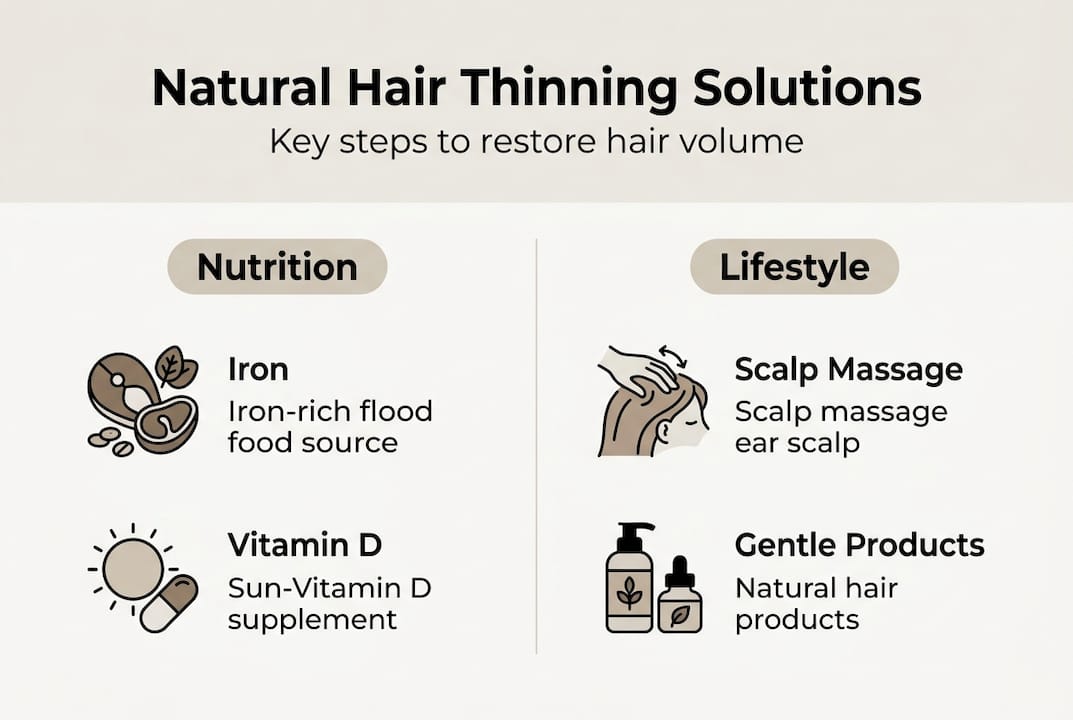
Nutrition first. Correcting iron and vitamin D deficiencies is critical for restoring the hair growth cycle. Low ferritin is one of the most commonly missed drivers of hair loss in women. Aim for ferritin levels above 70 ng/mL for optimal hair growth. Vitamin D supports follicle cycling and immune regulation. As for biotin, the evidence for supplementing beyond deficiency is weak, so avoid megadosing.
Beneficial botanicals. Saw palmetto, pumpkin seed oil, and horsetail have shown real promise for supporting hair density with fewer side effects than pharmaceuticals. Saw palmetto inhibits the enzyme that converts testosterone to DHT, making it particularly relevant for FPHL. Pumpkin seed oil has demonstrated measurable increases in hair count in clinical trials. Horsetail is rich in silica, which supports strand strength and elasticity.
Key natural interventions to consider:
- Iron-rich foods and supplementation if ferritin is low
- Vitamin D3 to support follicle health
- Saw palmetto as a gentle anti-androgen
- Pumpkin seed oil for DHT-blocking support
- Rosemary oil applied topically for circulation
- Scalp massage for 4 minutes daily to improve blood flow
Scalp care matters more than most realise. Regular scalp massage increases blood flow to follicles and, when combined with topical botanicals, enhances absorption. Microneedling (dermarolling at 0.5 mm) has shown positive results when used alongside serums, boosting active ingredient penetration significantly.

Pro Tip: Pair your hair growth oil with a 5-minute scalp massage before washing. This combination improves circulation and primes follicles for active ingredients in your serum or conditioner.
For vitamin support and topical actives, consistency is everything. Most women see visible density changes within 3 to 6 months when routines are followed daily. Explore natural hair serums formulated with these botanicals for targeted support.
Medical, pharmaceutical, and alternative treatments: what actually works?
Beyond natural methods, what should you know about clinical and medical options, especially if you are seeking faster or more dramatic results?
Minoxidil remains the most studied topical treatment for female hair loss. Topical minoxidil 2 to 5% increases hair density with approximately a 60% response rate. It works by prolonging the anagen (growth) phase and widening blood vessels around follicles. Results typically appear after 4 to 6 months of consistent use.
Here is how to think about your treatment options:
- Topical minoxidil (2% or 5%): First-line pharmaceutical option; well-tolerated by most women
- Oral minoxidil (low dose): Increasingly used off-label; effective but requires medical supervision
- Anti-androgens (spironolactone, flutamide): Relevant in cases with elevated androgens or PCOS; not suitable during pregnancy
- JAK inhibitors: FDA-approved for alopecia areata; less established for FPHL but emerging evidence is promising
- Platelet-rich plasma (PRP): Injections of concentrated growth factors; growing evidence base, requires clinic visits
Pro Tip: If you are using minoxidil, apply it to a dry scalp and wait at least 4 hours before washing. Combining it with a top hair serum containing botanical actives can amplify results without adding harsh chemicals.
“The most effective approach is rarely one treatment in isolation. Combining a pharmaceutical base with nutritional support and clean topical botanicals consistently outperforms any single intervention.”
Monitoring progress matters. Take monthly photographs in consistent lighting and track daily shed counts. Improvement in shedding rate often precedes visible density gains. Pair pharmaceutical treatment with scalp massage methods to maximise topical absorption and follicle stimulation.
What most approaches get wrong about hair thinning in women
As you weigh your options, it helps to know the hard truths, and where real transformations begin.
Most women reach for a new shampoo or serum before they have ever checked their ferritin levels or addressed chronic stress. That is completely understandable. Topical products are visible, immediate, and easy to try. But they are also the last layer of a multi-layered problem.
The research is consistent: women who address root causes first, correcting deficiencies, managing stress, and supporting hormonal balance, see significantly better outcomes than those who rely on topicals alone. Products work best as amplifiers, not foundations.
This is where premium, cruelty-free formulations genuinely earn their place. When your nutrition is dialled in and your stress is managed, a clean botanical serum or a biotin-rich shampoo becomes a powerful finishing layer. It is not about choosing between inside-out or outside-in. It is about doing both, properly. Explore natural fixes for hair thinning to build your full routine from the ground up.
Restore volume and confidence with premium, cruelty-free solutions
Ready to take the next step? Evidence-based lifestyle shifts work even better when paired with trusted, specialist formulas. ✨
At LUXEVASTORE, every product is designed to complement the holistic approach you have just learnt about. Clean ingredients. No sulphates. No parabens. 100% cruelty-free. Our biotin rosemary shampoo set combines proven botanicals in one powerful routine, supporting scalp health and strand strength from the very first wash.

Browse our full range of complete haircare sets and find the targeted formula that fits your hair goals. Whether you are restoring density after shedding or building volume over time, we have a clean, science-backed solution waiting. 🌿 Limited stock. Shop now and give your hair the care it deserves.
Frequently asked questions
What are the first signs of hair thinning in women?
FPHL often shows as a widening parting and reduced volume at the crown. Early signs also include a thinner ponytail and noticeably more hair collecting in the shower drain or on your brush.
Can hair thinning really be reversed naturally?
Natural interventions like saw palmetto, pumpkin seed oil, and correcting nutritional deficiencies support hair density and can lead to real improvement. However, genetic forms like FPHL require ongoing management rather than a one-time fix.
How long before I see results from natural or cruelty-free products?
Visible density changes typically appear within 3 to 6 months for natural interventions when used consistently. Shedding reduction is usually the first sign of progress, followed by increased volume.
Are cruelty-free hair products as effective as mainstream brands?
Premium vegan and cruelty-free products can be highly effective, particularly when formulated with plant-based actives like rosemary, biotin, and saw palmetto. Their performance is strongest when combined with good nutrition and consistent scalp care.